
Our goal: we help people
AI that makes your team stronger, not smaller
Two companies adopt AI. Both start with 5 employees and a productivity of 100. They end up in very different places.
Company A
Adopts AI to reduce the number of employees
- Output
- 0%
- Jobs
- −2
Employees
Productivity
The same company, fewer people
Company B
Adopts AI to increase productivity
- Output
- +50%
- Jobs
- 0
Employees
Productivity
The same people, a stronger company
We build Company B.
AI should strengthen people, not replace them. We judge a deployment by how much more your team can do, not by how many jobs were cut.
Our motto for the next 3 years
Start increasing your company's productivity with AI before others do.
Example: the same client in two scenarios
Where the numbers come from. All amounts in this example are assumptions. They are not market data or our price list. Amounts are in PLN.
Client: a mid-sized logistics company, order handling department.
| Assumption | Value |
|---|---|
| Team | 5 people |
| Gross salary | 8,000 a month |
| Employer cost per person | about 9,600 a month, 115,200 a year |
| Team cost | 576,000 a year |
| Margin earned by the team at productivity 100 | 1,000,000 a year |
| Our delivery: audit + MVP + deployment | 15,000 + 80,000 + 60,000 = 155,000 one-off |
| Our maintenance | 6,000 a month, 72,000 a year |
The AI cost is the same in both scenarios: 227,000 in the first year, then 72,000 a year.
How the client behaves
| Stage | Company A: fewer people | Company B: higher productivity |
|---|---|---|
| First question to us | “How many jobs can I cut?” | “How many more orders can the same team handle?” |
| How the team behaves | Resistance, knowledge about the process is withheld, the best people look for another job | Cooperation and ideas, because nobody loses their job |
| Months 1–3 | Deployment and notice for 2 people | Deployment and training for 5 people |
| Months 4–12 | 3 people handle the same volume; no reserve for holidays and peaks | The team gradually takes on more orders |
| After a year | The same sales, lower costs | Higher sales, the same payroll |
| Maintenance contract with us | Seen as a cost to cut | Seen as part of growth |
Where the 3-year result comes from
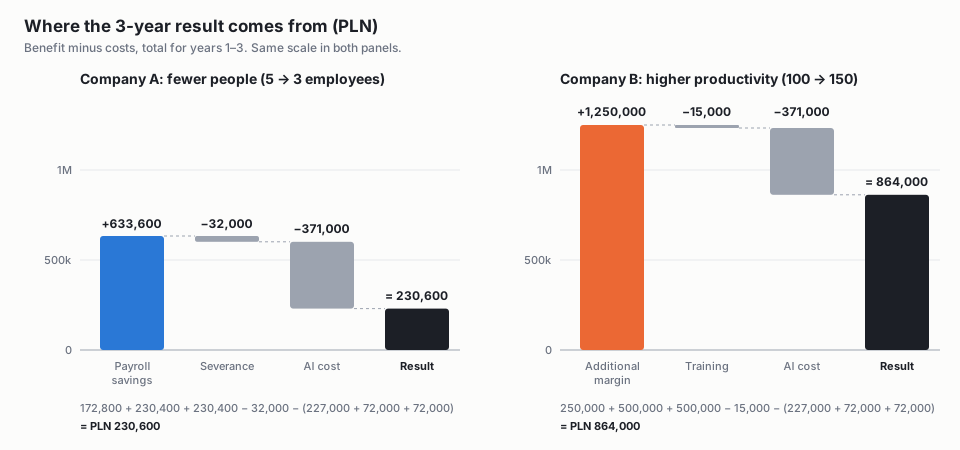
Company A: 5 → 3 people, productivity 100
| Item | Year 1 | Year 2 | Year 3 | Total |
|---|---|---|---|---|
| Payroll savings for 2 people | +172,800 | +230,400 | +230,400 | +633,600 |
| Severance (2 people × 2 salaries) | −32,000 | 0 | 0 | −32,000 |
| AI cost | −227,000 | −72,000 | −72,000 | −371,000 |
| Result | −86,200 | +158,400 | +158,400 | +230,600 |
In the first year the saving covers 9 months, because salaries are still paid during the 3-month notice period.
Company B: 5 → 5 people, productivity 100 → 150
| Item | Year 1 | Year 2 | Year 3 | Total |
|---|---|---|---|---|
| Additional margin | +250,000 | +500,000 | +500,000 | +1,250,000 |
| Team training (5 × 3,000) | −15,000 | 0 | 0 | −15,000 |
| AI cost | −227,000 | −72,000 | −72,000 | −371,000 |
| Result | +8,000 | +428,000 | +428,000 | +864,000 |
In the first year productivity grows gradually: +25% on average, and the full +50% from the second year.
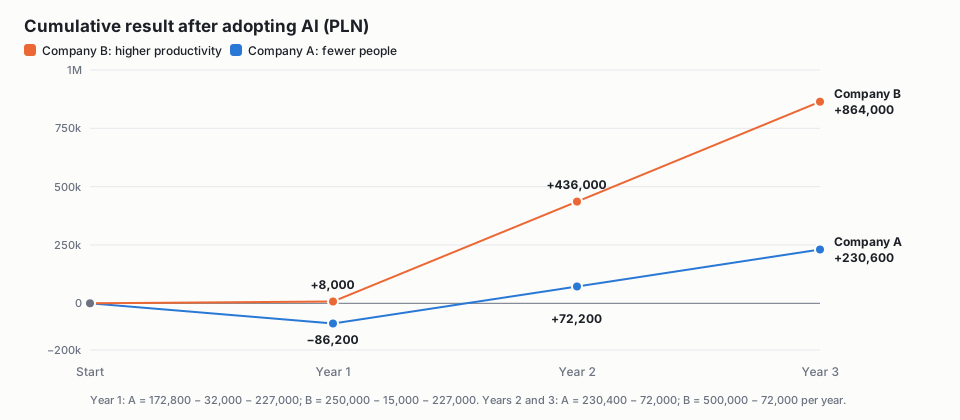
Cumulative result
| Company A | Company B | |
|---|---|---|
| Result after 3 years | +230,600 | +864,000 |
| Return on investment | in the second year | at the end of the first year |
| Upper limit of the benefit | the cost of the jobs cut | as much as the market will buy |
| Main risk | loss of knowledge, no staff reserve | no demand for the additional work |
When Company B stops winning
When B stops winning: the client must sell the additional work of the team.
| How much of the additional productivity the client sells | Additional margin in 3 years | Company B result after 3 years |
|---|---|---|
| All of it (+50%) | 1,250,000 | +864,000 |
| Half (+25%) | 625,000 | +239,000, about the same as A |
| None | 0 | −386,000 |
Conclusions
- In this example Company B earns almost four times more than Company A, but only if it has demand for the additional work.
- So in the audit we measure not only the process, but also whether the client has orders it cannot keep up with today.
- The example does not include taxes, the cost of recruitment when people leave Company A, or the cost of serving higher sales in Company B.
See it on your own data
We start with an MVP on your screens, devices or tickets. Request an MVP and bring a real use case.
Request MVP